|
||||||
New Excavation: Roman "Reversed" Mosaic Bacchus Image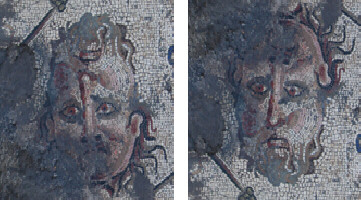 This is Roman illusionism at its finest and
probably stunned workmen who unearthed it! This 3rd
century fire-damaged mosaic Bacchus floor image
was discovered in May, 2006, in an excavation that was
exploring a renovation to a 1st century AD
Italian villa at Palazzo Morgano, an ancient site. The
mosaic image is assumed to be that of the Roman god
Bacchus, so attributed because certain cult objects of
the god Bacchus are represented in other images in the
same panel. The mosaic Bacchus image can be
viewed as two distinctly separate images when seen from
opposite viewpoints. Decorating the dining room of some
wealthy Roman, the mosaic Bacchus image appears
one way as a beardless young man, and from another view
as a bearded, bald old man. According to Dr. Mark
Merrony, the mosaic Bacchus image "would have made visual
sense to the viewer entering into the dining area as well
as when seated. This style of representation, heads
upside-down to each other as seen in this mosaic
Bacchus floor image, often with youths and
satyrs, is commonly found on engraved ring intaglios, but
is hitherto unknown in Roman mosaics." Late Italian
Renaissance/Mannerist painter, Giuseppe Arcimboldo, would
take this same idea of representation to a new level with
his fantastic, illusionistic portraits. This is Roman illusionism at its finest and
probably stunned workmen who unearthed it! This 3rd
century fire-damaged mosaic Bacchus floor image
was discovered in May, 2006, in an excavation that was
exploring a renovation to a 1st century AD
Italian villa at Palazzo Morgano, an ancient site. The
mosaic image is assumed to be that of the Roman god
Bacchus, so attributed because certain cult objects of
the god Bacchus are represented in other images in the
same panel. The mosaic Bacchus image can be
viewed as two distinctly separate images when seen from
opposite viewpoints. Decorating the dining room of some
wealthy Roman, the mosaic Bacchus image appears
one way as a beardless young man, and from another view
as a bearded, bald old man. According to Dr. Mark
Merrony, the mosaic Bacchus image "would have made visual
sense to the viewer entering into the dining area as well
as when seated. This style of representation, heads
upside-down to each other as seen in this mosaic
Bacchus floor image, often with youths and
satyrs, is commonly found on engraved ring intaglios, but
is hitherto unknown in Roman mosaics." Late Italian
Renaissance/Mannerist painter, Giuseppe Arcimboldo, would
take this same idea of representation to a new level with
his fantastic, illusionistic portraits.
Brenda Harness, Art Historian For more information on Italian Renaissance Art and book recommendations, click here. | ||||||
|
 QUOTE
QUOTE
|
Welcome ! |
|
We respect your privacy and will never sell your personal information. |
| Click here to sign up for our newsletter. |
Buy great
art books
at Amazon!
Home Glossary of Terms Contact Us About Us Newsletter Subscription