|
||||||
You Can Talk About 'Women As Edible Art' by Using MetaphorsThis article was published in December, 2006 under the following title. Women As Edible ArtThere is a real art to saying something without really saying it. In other words, you can say something by <i>not</i> saying it if you 'talk around' a topic. By using metaphors, one can talk about almost anything, even the topic of 'Women as Edible Art.' Confusing enough? Read on. My lesson in 'talking around' edible art came when I was in graduate school. I bonded strongly with another single mother who was taking a similar course of studies in art history. My kids and I were new in town having moved from another state, leaving behind bad memories and looking forward to a new life and a fresh start. I was excited to be back in school and doing something besides just being a mother. I was no longer a wife and neither was my new friend, Jean, who sat with me in the student cafeteria between classes, where we drank coffee and talked. We shared stories about kids, about work, about love lost, about love found, about despair, and about happiness. As my last semester came to a close, I remember fondly one particular day when we were sitting in a darkened classroom as images flashed by on the screen. Baroque and Rococo Art was the name of the course. We sat mesmerized as we listened to our gifted instructor, a venerable, silver-haired gentleman who was head of the department and soon to retire. After 40 years of teaching, he was an engaging speaker with a relaxed oratorical style. He was knowledgeable, well traveled, and married to the perfect woman, a travel agent. It seemed to me that it was a marriage made in heaven. Each complemented the other since he knew about everything, and she knew where everything was and how to get there affordably. Who could ask for more? Well, on this particular day, we finished Renaissance Art with Correggio's Jupiter and Io, a mythological painting in which the priestess Io is being seduced by Jupiter, who envelops the nude woman in his disguise as a cloud. Being king of the Greek gods gave Jupiter quite a bit of leeway and seducing young women was one of his favorite pasttimes. As Io swoons in Jupiter's cloudy embrace, I heard the words uttered, 'this tasty morsel,' and I wondered if it was close to lunch time. An excellent note taker, I hastily jotted down 'tasty morsel' and thought about the blue plate special. The professor left Baroque Art and went on to tell us about Rococo Art, a much needed breath of fresh air after a heavy course load and an endless series of term papers. Light-hearted in spirit with its atmospheric effects, delicate, pastel colors, dynamic, sensual compositions, and emotional content, Rococo Art brings a smile to the face of even the dourest of men. I was shortly to realize that my professor was a man with an epicurean taste for women. As we listened in the dark, he described the next female image on the screen as 'this juicy tidbit.' This time it didn't catch me off guard, because the 'tasty morsel' had already awakened me from my comfortable malaise and gotten me thinking about food. I looked over at Jean to see if that 'juicy tidbit' remark had registered with her. It had, and we smiled conspiratorial smiles at each other. The lecture continued. Now we were both fully alert, anxiously waiting to hear what the next culinary offering would be. On the screen, I saw the final image of a young woman who was face down on a chaise lounge, a little plump and totally nude. The young woman in the painting was identified as Mademoiselle O'Murphy by Francois Boucher. The professor described her as a 'delicious tart.' I looked at Jean. She was already looking at me with wide eyes. We both rolled our eyes and spent the remainder of the class trying to keep a straight face and conceal our chuckles.
While I led a sheltered life, I am a fast learner. I learned that day that most men would think Mademoiselle O'Murphy was a 'delectable dish' (my words). Although I am sure it was probably not the intended lesson, the lesson I learned that day was that one should always save the dessert for last. Brenda Harness, Art Historian _________________ Brenda Harness is a practicing artist, art historian, and former university teacher writing about a variety of topics pertaining to art and art history. Visit her at Fine Art Touch. For more information on Italian Renaissance Art and book recommendations, click here. | ||||||
|
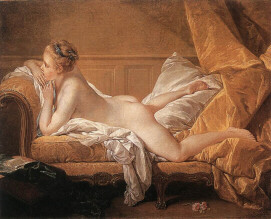 I'm not shocked by nude figures in art, as I've
looked at them for most of my adult life both in and out
of school. But, until that day, I had no idea that men
think of women in edible terms. I know my professor had
the utmost respect for women, but I didn't know that he
had an epicurean, gourmet taste for the female of the
species. This was a great revelation to me, and I have to
agree with his assessment of the gorgeous
Mademoiselle O'Murphy. She was quite a
stunner.
I'm not shocked by nude figures in art, as I've
looked at them for most of my adult life both in and out
of school. But, until that day, I had no idea that men
think of women in edible terms. I know my professor had
the utmost respect for women, but I didn't know that he
had an epicurean, gourmet taste for the female of the
species. This was a great revelation to me, and I have to
agree with his assessment of the gorgeous
Mademoiselle O'Murphy. She was quite a
stunner. QUOTE
QUOTE
|
Welcome ! |
|
We respect your privacy and will never sell your personal information. |
| Click here to sign up for our newsletter. |
Buy great
art books
at Amazon!
Home Glossary of Terms Contact Us About Us Newsletter Subscription