|
||||||
Simonetta VespucciThis article was published in December, 2007 under the following title. Simonetta Vespucci: The Face That Launched A Thousand Prints
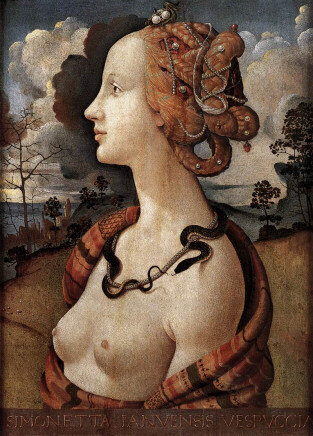
Shortly after her arrival in Florence, Simonetta became known as "La Bella Simonetta," attracting the attention of poets and artists like Botticelli. They vied to honor her with their artistic creations. At the age of fifteen, Simonetta married a cousin of Amerigo Vespucci, the famous Italian explorer for whom America was named. It was through the Vespucci family connection that Simonetta first met Botticelli and the Medici family, prominent political figures and art patrons. Giuliano de' Medici was the younger brother of Lorenzo de' Medici, a wealthy aristocrat who was referred to by his admirers as "Il Magnifico" or Lorenzo the Magnificent for his generosity and lavish lifestyle. Little information exists about Simonetta’s early life. Some scholars believe she was born in Genoa, while others say she came from Portovenere, a town in Liguria and the supposed birthplace of the goddess Venus. Not only was she Botticelli’s Venus, but she was also painted as Cleopatra by the eccentric Florentine Piero di Cosimo who depicted Simonetta with snakes entwined about her neck. Simonetta, "the unparalleled one," personified ideal beauty. The personification of ideal beauty was an important concept to Italian Renaissance artists like Botticelli who thought that outward beauty reflected inner beauty or virtue (spiritual beauty). Simonetta died young in 1476 at the age of twenty-two from tuberculosis, but Botticelli continued to feature her image in his art for the next three decades. Most of Botticelli's female art images were portraits of Simonetta, her face even appearing several times within some compositions. At some time before his death thirty-four years later, Botticelli requested to be buried at Simonetta's feet. His request was granted and both are interred in the Vespucci parish church of Chiesa d'Ognissanti in Florence, Italy. Brenda Harness, Art Historian ------------------------------------ Brenda Harness is a practicing artist, art historian, and former university teacher writing about a variety of topics pertaining to art and art history. Visit her at Fine Art Touch. For more information on Italian Renaissance Art and book recommendations, click here. | ||||||
|
 QUOTE
QUOTE
|
Welcome ! |
|
We respect your privacy and will never sell your personal information. |
| Click here to sign up for our newsletter. |
Buy great
art books
at Amazon!
Home Glossary of Terms Contact Us About Us Newsletter Subscription